

You’ve spent months working on the asset.
The clinical strategy has been debated. The data have been reviewed from every angle. The key questions are building up nicely in a document somewhere. You’ve identified experts, found a date, and started pulling together the slides and pre-read.
At that point, it can feel like the hard work is done.
All that remains is to get the experts on the call and ask the questions.
But there is one deceptively simple decision that can have a huge impact on the quality of the discussion:
Who is going to moderate the advisory board?
For many pharma and medtech teams, the default answer is an internal person.
That makes sense on paper. They know the science, know the strategy, and know what the team wants to get out of the session.
But that same closeness can also create blind spots.
Because the people most invested in the answer are not always the people best placed to run the room.
This is not a criticism of internal teams. Most are smart, thoughtful, and very well prepared. The issue is not competence. It is proximity.
The closer you are to the product, the evidence package, and the hoped-for outcome, the harder it becomes to create a genuinely balanced, probing, and open discussion that is willing to confront uncomfortable answers.
That is where an external moderator can add real value.
Not because they are magically wiser, but because independence usually improves the process at every stage: who you recruit, what you ask, how the discussion unfolds, and how honestly the findings are written up.
The first mistake usually happens before the meeting starts
One of the biggest misconceptions about advisory boards is that the important bit is the meeting itself.
In reality, a lot of the value is won or lost before anyone joins the call.
Recruit for perspective, not just prestige
It is tempting to start with the five biggest names in the field and assume the rest will take care of itself.
Sometimes that is the right choice. But often it is not.
Depending on the question you are trying to answer, the most established KOLs may not give you the most useful spread of perspectives. If your asset is differentiated, you may need someone outside the usual bubble. If the topic is evolving, you may want a rising expert rather than only the familiar senior voices.
The best panel is not always the most impressive on paper. It is the one most likely to challenge your thinking.
An external moderator or research lead can help here by shaping the group around the decision you need to inform, rather than defaulting to the usual suspects.
Trim the discussion guide before it becomes an endurance event
This is another common problem.
By the time an advisory board is being planned, Medical, Clinical, Commercial, and Market Access may each have their own priorities to cover. Then somebody wants to test a message, and somebody else wants feedback on a slide.
Before long, the guide has become less of a discussion tool and more of a parking lot for every unresolved question.
What works in a one-to-one interview does not work in a five-person advisory board. The moment there is debate, disagreement, or one KOL answering in elegant, detail-rich ten-minute instalments, the number of questions you can cover drops sharply.
The aim is not to ask everything. It is to ask the questions most likely to generate useful disagreement and move decision-making forward.
A good external moderator is often most valuable at this stage because they are willing to say: You do not need twelve questions on this topic, and these two questions are actually the same question in different shoes.
Make the pre-read readable by actual humans
The medical or clinical team is usually best placed to create the content of the pre-read.
But being closest to the material can also make it harder to judge whether it is digestible.
A 120-slide background pack may feel sensible internally, covering everything about the asset. To an external expert with clinics, research deadlines, and three other advisory boards that month, it may feel rather harder to absorb than intended.
An external pair of eyes can help strike the right balance: enough technical detail to prepare people properly, but not so much that the key asks get lost under a small mountain of context.
The live meeting is where external moderation earns its keep
This is the stage where the value becomes most obvious.
Someone has to run the room, not just ask the next question
A good advisory board is not simply a matter of moving through a guide.
Someone needs to keep time, balance airtime, stop one person dominating, know when to probe, and know when a useful tangent is worth following.
That sounds straightforward until the room contains senior experts whose work your team has followed for years, whose papers are in your deck, and who are perfectly capable of answering one question for twelve uninterrupted minutes.
An independent moderator brings useful distance. They are less likely to be influenced by hierarchy or reputation in the moment, less caught up in internal stakeholder dynamics, and more comfortable redirecting the discussion when needed.
That matters because the biggest risks in advisory boards are often not dramatic failures. They are quieter issues: one person dominates, two others barely speak, the discussion circles the same point, and the most useful disagreement never quite comes to the surface.
The goal is a better understanding, not a room that agrees too quickly
One of the most valuable things an advisory board can reveal is disagreement.
If everyone agrees quickly with the framing, the assumptions, and the direction of travel, that may mean your team is brilliantly aligned with the field.
Or it may mean the discussion has been shaped in a way that makes disagreement less likely.
A strong external moderator will probe the minority view, draw out tension, and invite alternatives before moving on.
Sometimes, the most useful moment in an advisory board is when one expert says, “I actually don’t agree with that at all.”
That is not the meeting going wrong. That is usually the meeting doing its job.
Your internal team should be listening, not traffic controlling
This is one of the most practical benefits of external moderation.
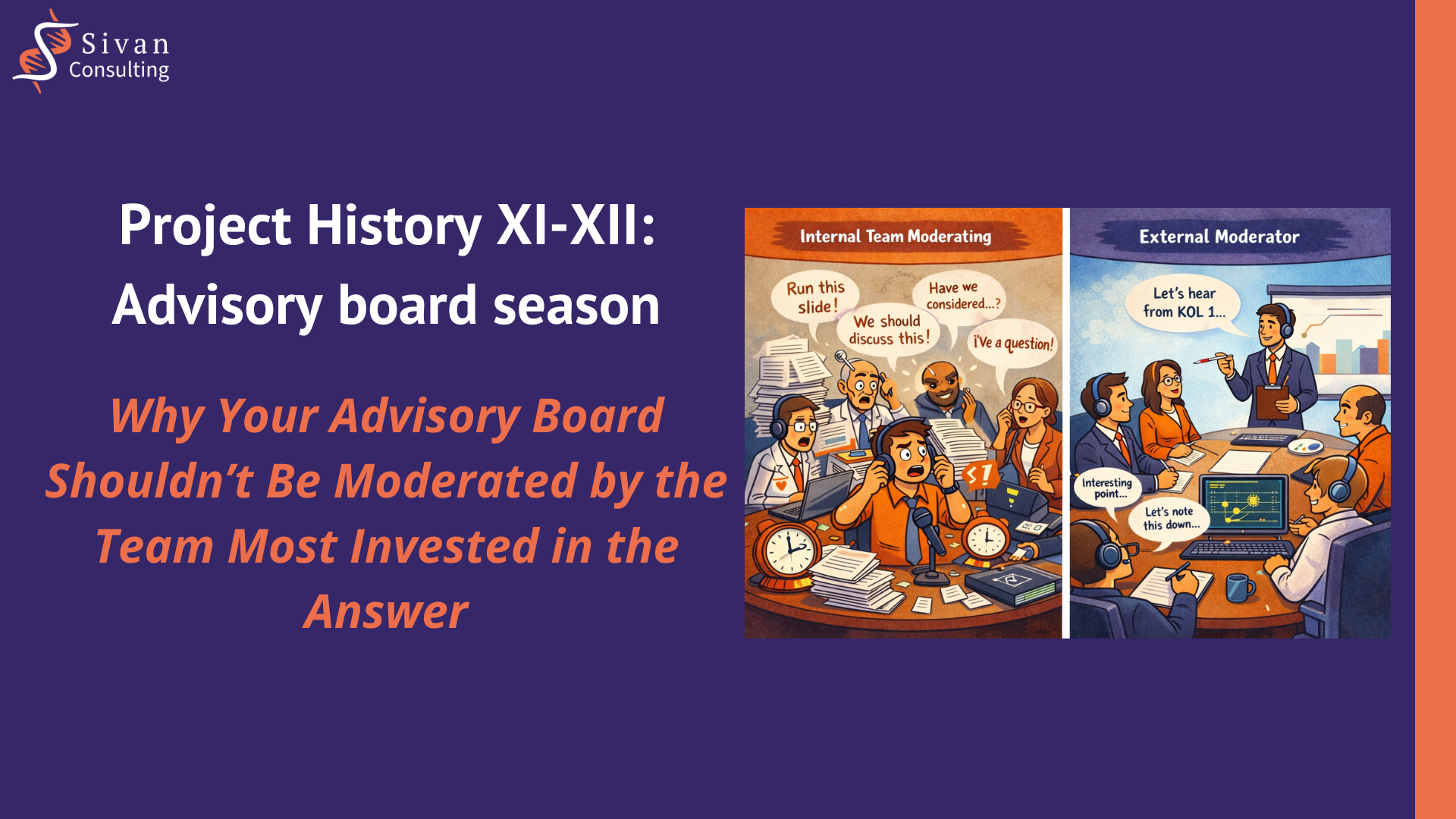
If the company is running the meeting itself, the internal team is usually trying to do several jobs at once: chairing the call, tracking the agenda, watching the clock, managing slides, deciding which question to cut, and keeping an eye on compliance boundaries.
At the same time, they are meant to listen carefully to what the experts are actually saying.
That is a lot to ask.
An external moderator changes the dynamic. The internal team can focus on listening, spotting patterns, and developing sharper follow-up questions if new themes emerge.
In other words, they can behave like discerning listeners rather than anxious air traffic controllers.
Bias does not disappear when the meeting ends
The final risk comes afterwards.
Because the quality of an advisory board is not judged only by the discussion itself, but by how clearly and honestly the findings are written up.
This is where internal bias can creep back in.
Not usually because anyone is trying to mislead, but because teams are often better at absorbing supportive feedback than sitting with awkward truths.
Positive reactions get more airtime. Critical comments become “areas for future exploration.” Disagreement gets smoothed over. Before long, the summary sounds cleaner and more reassuring than the actual room did.
An external moderator can help by bringing a bit more distance to the synthesis. They are often better placed to capture what really happened: where there was consensus, where there was tension, what surprised the group, and what that means for next steps.
That is not just note-taking.
That is where the meeting becomes strategically useful.
So should every advisory board use an external moderator?
Not necessarily.
Plenty of companies run advisory boards internally and do it well.
But the more strategically important the topic, the more differentiated the asset, or the greater the risk that the team may hear what it hopes to hear, the stronger the case for independent moderation becomes.
And even if you do run it internally, the same principles still apply:
- Recruit for perspective, not just profile
- Cut the guide harder than feels comfortable
- Make the pre-read genuinely readable
- Create room for disagreement
- Make sure someone is focused on the quality of the discussion, not just getting through the agenda
The best advisory boards should do more than validate your current thinking. They should make your strategy better.